Sitting on the beach with a Coco Loco in hand is all well and good, but we couldn’t possibly go to the Dominican Republic and not visit Santo Domingo: it’s the oldest ‘modern’, (ie. post colonial), city in the Caribbean as well as the largest by population size. It’s on the south side of the island, about a 2.5 hour drive from Punta Cana, so it’s an early start and long day. On the Friday, we woke up at the ass crack of dawn to a rain storm and started our journey…




From the bus, we could see a huge statue , (I couldn’t get a decent picture from the bus so Google images is doing my job for me here), of Fray Antonio de Montesinos. He was a Dominican friar, (Dominican being a specific Catholic order), who lived and worked as a missionary on the island during the colonial period. Our guide told us that this was his statue of liberty – Fray Antonio de Montesinos reported abuse of the native Tainos by the Spaniards and denounced the enslavement and cruel treatment of indigenous peoples across Latin America. Thanks to Fray Montesinos, the Laws of Burgos were passed which regulated the treatment of indigenous peoples by the colonisers. The statue was given to the Dominican Republic by the Mexican Government as it’s believed that the Laws of Burgos helped to maintain the indigenous populations across Central and Latin America.
We also got a glimpse of the DR’s ‘White House’ which is more pink in colour and named the National Palace. Built by horrific dictator Trujillo, this huge and pretty stunning building was used for him to hide out after a number of assassination attempts. Eventually though, he got taken out in 1961 ending his 31 year rule.
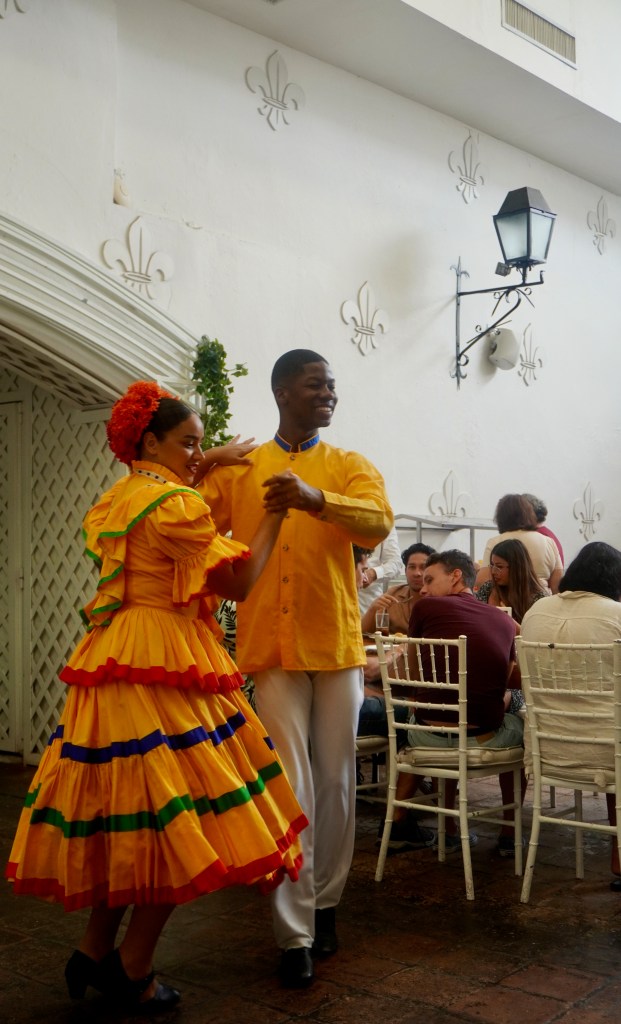
Thankfully, the sky cleared just in time for us to jump off the bus and head for food. A buffet style lunch with 2 drinks and a coffee were included in the trip at Restaurante Atarazana which was very cute. The highlight for me was a, (slightly random), dance performance in trad. clothing which was good fun.
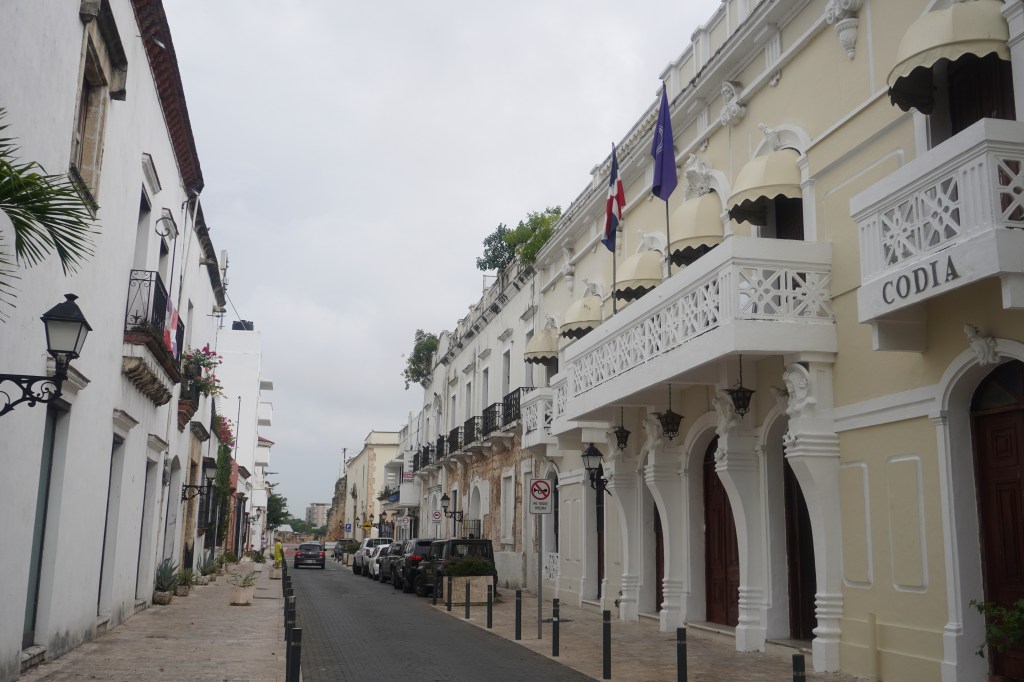
We then headed off for our walking tour which included some ruins, a museum, Calle las Damas and the Cathedral. With the island of Hispaniola being the first place Columbus ‘discovered’, and the DR being where the Spanish maintained power, his son and family were pretty settled so you can see the ruins of Diego Columbus’, (Chris’ sons), house. His house was actually destroyed by Francis Drake under order from Elizabeth I.
The oldest and longest road in the city is Calle las Damas or ‘Street of the Ladies’. Diego Columbus’ wife, Maria de Toledo, obviously didn’t speak the language of the natives, so instead of learning the language, (God forbid!), they shipped over 30 Spanish ladies in waiting for her to have company. They would walk along that stretch of road everyday and, hence, it got its name.
Our first real stop was at the Museo de las Casas Reales which is a whole history lesson of the DR and the island as a whole. It has Christopher Columbus’ manuscripts and replicas of the ships the colonisers arrived on, as well as the history of uprisings of the native Taino’s against said Europeans. It has a map of Hispaniola and we were told about how it was divided up into 2 distinct countries. It delves into the period of the Transatlantic Slave Trade with exhibits of the shackles used on enslaved people. If my Mum would have had the chance, I think she could have spent a whole afternoon here!
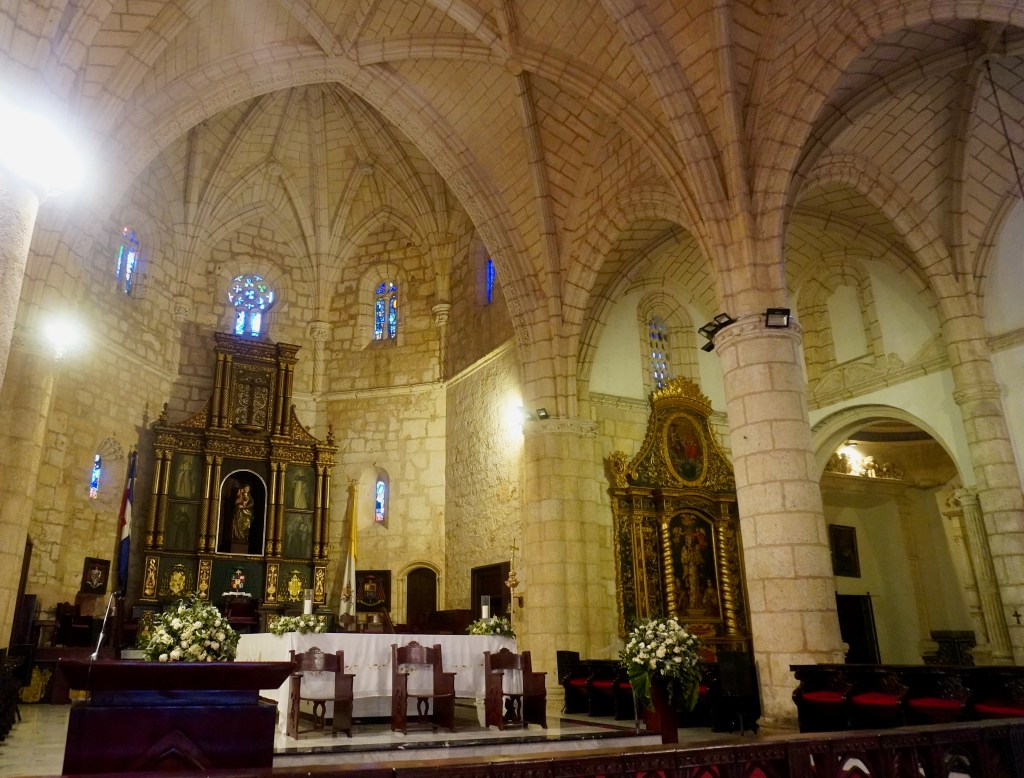
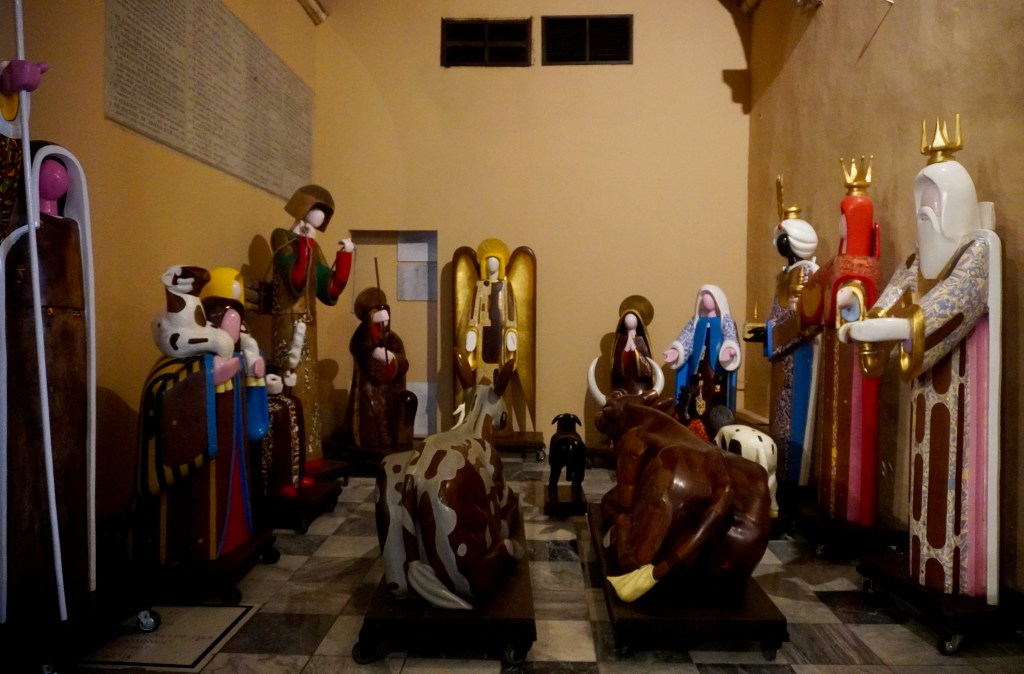
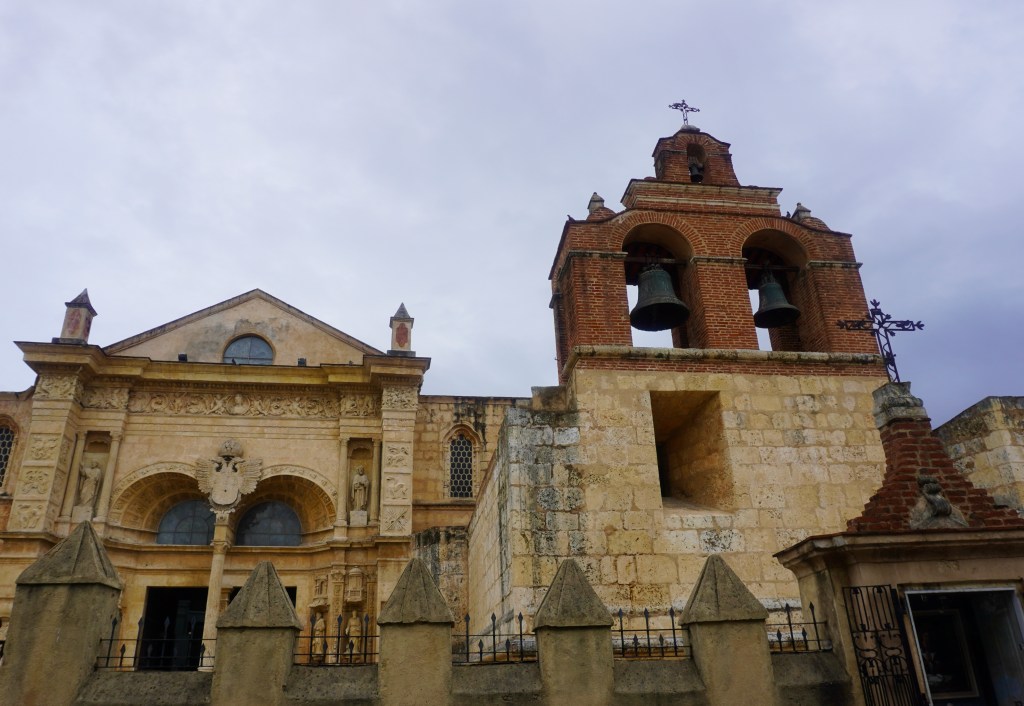
Thankfully for me, we moved onto the Santo Domingo Cathedral. That’s the shorthand, seeing as its full gov. name is the Cathedral Basilica Virgin Mary of the Annunciation – quite the mouthful for the first Church in the ‘New World’. Anyways, as we all know by now, I love a cathedral. Whilst it’s no where near as grand as Seville Cathedral or Mallorca Cathedral, it’s still beautiful and brings me the same feeling of calm. There is a year round nativity scene which was described as a traditional Dominican Republic nativity. The characters are faceless but have different skin tones in order to represent the melting pot of ethnicities in the DR – notably, there’s no baby Jesus in the manger.
The cathedral itself began life in 1512 but once Columbus died and Hernán Cortés took over, he moved most of those in a position to build the church to Veracruz, Mexico. The locals left tried their best to finish it but it was slow going. By 1546 the cathedral itself was pretty much complete, however, there were no bell towers. You can see the obvious difference in the building materials but the bell towers were finally built. The ones you can see in the pictures aren’t the original bells: you’ll find those somewhere in the ‘British’ Museum.
We booked this trip through Tui Experiences. Our guide ‘Obama’, (once you see it, you can’t unsee it), was incredible. He was incredibly knowledgable and is the definition of polyglot. The tour itself, I would describe as okay. I guess by proxy of the city being so large, it would be hard to get off to properly explore everything, however, I would have loved to have gotten off the bus to see the statue of the Fray and have had more free time in the Zona Colonial. There are two stops to gift shops which I reckon are too long, verging on unnecessary, (you could use your free time to go shopping in my opinion). I reckon going to the Three Eyes Lake could be a better shout. All in all though, it was a good day out and we learnt a lot. Our Cultured Chica enrichment was checked off. It was now time to return to the beach – this time, with a fresh Piña Colada in hand.
 Dear Disha